



Looking for a Fiddler alternative that simply works?
HTTP Debugger Pro is a powerful Fiddler alternative for Windows. It shows real HTTP and HTTPS traffic from your web applications, APIs, microservices, and desktop apps in a clean, user-friendly interface.
With HTTP Debugger Pro, you don't need to run a local proxy server on your computer and interfere with the normal operation of the system by changing proxy servers.
HTTP Debugger Pro gives you instant visibility into all HTTP/HTTPS traffic, so you can intercept, inspect, and troubleshoot requests and responses with zero-setup and no proxy overhead.
Why many teams move beyond classic proxy-based debuggers
Fiddler and other HTTP debugging proxies have been used for many years. However, in Windows environments they often introduce friction that has nothing to do with the issue you are trying to fix.
- 1) System-wide proxy changes that may conflict with corporate proxies, VPN clients, or PAC files.
- 2) If an application does not support using an HTTP proxy, proxy-based tools simply cannot capture its traffic.
- 3) Traffic from applications started before the proxy was enabled can be missed, because these apps may not react to proxy change events and keep using their original connections and settings.
- 4) Risk of breaking connectivity on the workstation when proxy settings are frequently changed during debugging sessions.
For over 15+ years, development and QA teams worldwide have relied on HTTP Debugger Pro as a proven, proxy-free alternative that delivers focused HTTP/HTTPS analysis without proxy overhead.
Meet HTTP Debugger Pro - proxy-less Fiddler alternative for Windows
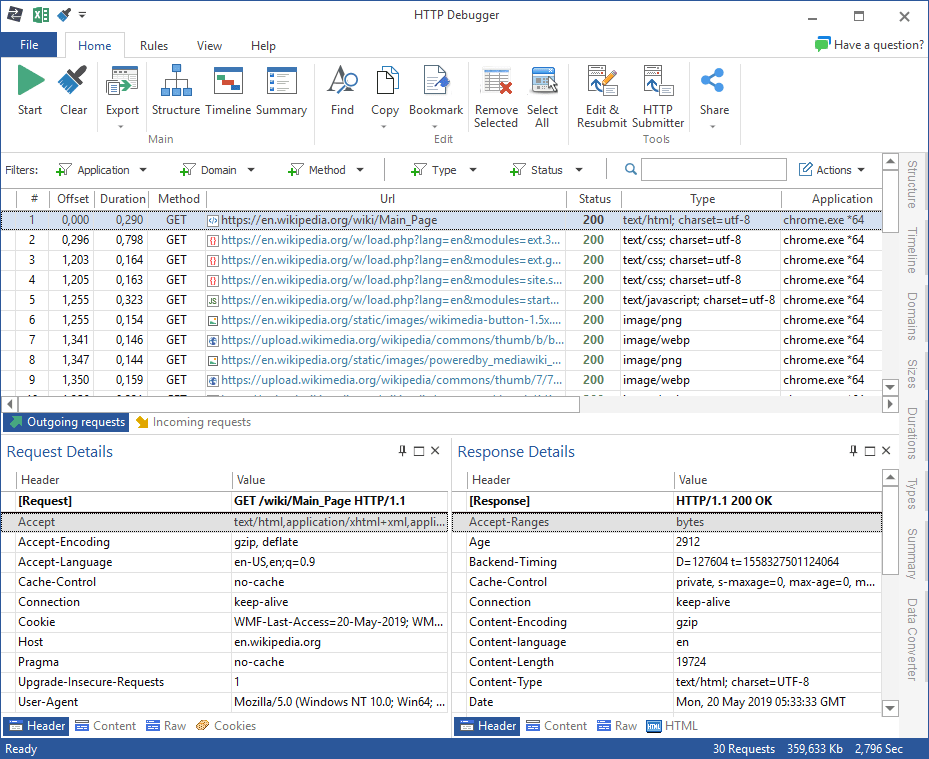
HTTP Debugger Pro captures HTTP and HTTPS traffic directly from browsers and Windows applications over any network connection, including LAN, Wi-Fi, other network adapters, VPN tunnels, and applications whose traffic is already routed through an upstream or corporate proxy.
From a single HTTP Debugger Pro interface you can:
- 1) Capture and analyze HTTP headers, cookies, POST parameters, HTTP content and CORS headers from any browser or desktop application.
- 2) Debug HTTP API calls to a back-end and between back-ends in distributed systems and microservices.
- 3) See all details of each request and response: URLs, methods, status codes, timing, payload sizes and content types.
- 4) Automatically highlight errors, slow and large requests and define your own highlighting rules in one click.
- 5) Visualize traffic as charts to quickly find the slowest endpoints, largest payloads, most requested domains and content types.
- 6) Edit and resubmit HTTP sessions to test authorization flows, reproduce edge cases and validate fixes.
- 7) Decrypt SSL/HTTPS traffic from browsers, desktop apps, Android emulators and typical .NET/JAVA applications.
- 8) Export captured data to Excel, JSON, XML, TXT or CSV for further analysis and reporting.
HTTP Debugger vs Fiddler
Both Fiddler and HTTP Debugger allow you to inspect and modify HTTP/HTTPS traffic. The main difference is architectural and operational:
- 1) Proxy-less vs proxy-based. HTTP Debugger is a proxy-less HTTP sniffer; it does not require configuring a system proxy in browsers or Windows settings. Fiddler is an intercepting proxy and normally becomes the system proxy while running.
- 2) Compatibility with existing proxies. HTTP Debugger can analyze traffic even when the application already talks through a corporate or upstream proxy; you do not have to replace it during debugging.
- 3) Stability of the environment. Because there is no proxy toggle at the OS level, HTTP Debugger is much less likely to break other applications on the workstation.
If your main goal is to debug HTTP API calls, investigate CORS and authorization problems, or understand performance issues between services, the proxy-less model tends to be simpler and safer to operate.
Where HTTP Debugger gives you the most value as a Fiddler replacement
- 1) Debugging applications that do not support working through an HTTP proxy and always connect directly to the Internet.
- 2) Performing security checks and traffic analysis for applications that were started before any proxy server was enabled on the system.
- 3) Analyzing HTTP logs from your customers' machines using the dedicated HTTP Debugger logging component.
- 4) Investigating authentication and OAuth issues. See exactly which headers, cookies, tokens and redirects are actually sent over the network.
- 5) Finding performance bottlenecks. Use automatic highlighting and charts to locate slow endpoints, heavy responses and inefficient content types.
- 6) Working with Android emulators or test rigs. Decrypt and analyze HTTPS traffic coming from emulators and IoT-like devices without reconfiguring the whole environment around a proxy.
Where other HTTP debugging tools still fit
The HTTP debugging ecosystem is broad: developers, QA and security engineers also use intercepting proxy tools (Charles Proxy, Proxyman), open-source proxies and CLI tools (HTTP Toolkit, mitmproxy), deep packet analyzers (Wireshark), security testing proxies (Burp Suite, OWASP ZAP) and API client applications (Postman, Insomnia). Browser-integrated extensions like HttpWatch or Requestly complement these by focusing on single-browser scenarios.
When the basic features of browser dev tools, generic proxies, or low-level packet sniffers are not enough - or you simply want to save time and focus directly on debugging your issue - HTTP Debugger Pro is a practical choice. It is a professional, proxy-free HTTP/HTTPS traffic analyzer for Windows, primarily focused on day-to-day debugging work for developers and QA engineers, helping you stay focused on fixing your issues and quickly finding the root cause of HTTP-related problems.
How to switch from Fiddler to HTTP Debugger Pro in a few minutes
- 1) Download HTTP Debugger Pro and install on the same Windows machine where you previously ran Fiddler.
- 2) Start HTTP Debugger Pro and it will immediately begin capturing HTTP/HTTPS traffic on the system.
- 3) Run the application you want to debug (browser, API client, desktop app, emulator) and reproduce the issue.
Can Fiddler and HTTP Debugger Pro run on the same computer?
Yes. HTTP Debugger Pro uses a different approach to intercept and analyze HTTP/HTTPS traffic, so it can run side by side with Fiddler on the same Windows machine.
Why teams pick HTTP Debugger Pro as their Fiddler alternative
- 1) Proxy-less architecture. No proxy reconfiguration, fewer side effects, and better coexistence with complex enterprise networks.
- 2) Focused on HTTP debugging. Designed by developers who work with HTTP/HTTPS every day, with workflows optimized around real-world API and web debugging tasks.
- 3) Clean UI and short ramp-up time. New team members can become productive quickly without learning a complex proxy toolchain.
- 4) Used in thousands of companies worldwide. HTTP Debugger is battle-tested in production teams ranging from small product companies to large enterprises.
Try HTTP Debugger Pro as your next Fiddler alternative
If you are ready to move from a classic proxy-based debugger to a proxy-less HTTP sniffer optimized for Windows development, HTTP Debugger Pro is a practical next step.
FAQ: HTTP Debugger Pro vs Fiddler
Is HTTP Debugger Pro a proxy server?
No. HTTP Debugger Pro is not a proxy server and does not set itself as a system proxy. It uses a different approach to capture HTTP/HTTPS traffic, which helps avoid proxy-related network issues and conflicts with corporate proxies or VPN clients.
Can Fiddler and HTTP Debugger Pro run on the same computer?
Yes. Because HTTP Debugger Pro is not a proxy and uses a different capture mechanism, it can run side by side with Fiddler on the same Windows machine.
Will HTTP Debugger Pro see traffic from applications that do not support proxies?
Yes. HTTP Debugger Pro captures HTTP/HTTPS traffic directly from browsers and Windows applications, regardless of how they connect to the Internet - through a proxy server or directly without proxy support.
Does HTTP Debugger Pro work with VPNs and corporate proxies?
Yes. HTTP Debugger Pro can capture traffic over LAN, Wi-Fi, other network adapters, and VPN tunnels, and it can also monitor applications whose traffic is already routed through an upstream or corporate proxy.
Can HTTP Debugger Pro decrypt HTTPS traffic?
Yes. HTTP Debugger Pro can decrypt SSL/HTTPS traffic from typical browsers, desktop applications, Android emulators, and common .NET/JAVA applications, allowing you to see request and response bodies, headers, cookies, and parameters in clear text.
What platforms does HTTP Debugger Pro support?
HTTP Debugger Pro is designed for Windows desktops and servers and supports Windows 7, 10, and 11, both 32-bit and 64-bit.
Can HTTP Debugger Pro fully replace Fiddler in my daily work?
Yes. HTTP Debugger Pro lets you inspect and modify HTTP/HTTPS traffic from browsers, APIs, microservices, and desktop applications on Windows, so you can use it as your primary tool for day-to-day HTTP debugging instead of Fiddler.
Copyright Notice: Please don't copy or translate this article without prior written permission from the HTTPDebugger.com
HTTP Debugger is a proxy-less HTTP analyzer for developers that provides the ability to capture and analyze HTTP headers,
cookies, POST params, HTTP content and CORS headers from any browser or desktop application.
Awesome UI and very easy to use. Not a proxy, no network issues!
Download FREE 7-Day Trial
HTTP Debugger
 Debug HTTP API calls to a back-end and between back-ends.
Very easy to use.
Not a proxy, no network issues!
Download Free Trial
Debug HTTP API calls to a back-end and between back-ends.
Very easy to use.
Not a proxy, no network issues!
Download Free Trial